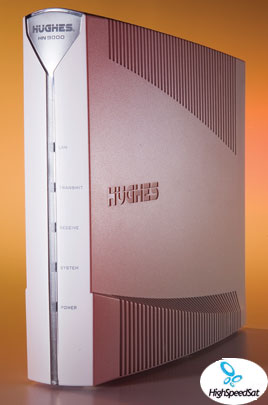
Hughes HN9000 terminal - Spaceway system is not a hardware product, but
an integrated satellite internet service platform. ![]()
HughesNet® Spaceway™ HN9000 The HN9000 satellite modem connects to the Internet or an intranet by satellite and provides Internet or intranet service to a single host, typically a computer, or to multiple hosts on a LAN. A host may be a computer using Windows or other support operating system. The modem is a self-hosted unit, meaning that it does not depend on a computer to establish and maintain the Internet or intranet connection. However, the modem must be connected to a properly aligned satellite antenna. The modem has an Ethernet port so it can be connected to a computer or to an Ethernet LAN.
The modem has a System Control Center that provides access to system information such as the modem's IP address and subnet mask. You may need this information to configure a network.
Operate the HN9000 modem only in a vertical position, that is, resting on its built-in base. In any other position, the modem may overheat and malfunction because of inadequate ventilation.
SPACEWAY is a next-generation satellite system whose unique capabilities will enable high-speed data networking, enable groundbreaking applications, and unlock a wealth of value-added HughesNet services. Operating in globally-assigned Ka-band spectrum, SPACEWAY employs high-performance, onboard digital processing, packet switching, and spot-beam technology to offer direct site-to-site connectivity at rates of from 512 Kbps up to 16 Mbps. SPACEWAY combines the traditional advantages of satellite, namely ubiquitous reach and efficient broadcast/multicast, with high data rates and mesh connectivity—to give customers a fast, efficient, flexible, and cost-effective communications solution.
Through use of advanced multi-spot-beam antenna and onboard data processing technologies, SPACEWAY satellites are at the vanguard of the most advanced next generation high-capacity Ka-band satellites. Such capabilities are the foundation for a host of advanced features such as full-mesh, single-hop connectivity among customer terminals. SPACEWAY represents the most sophisticated advanced packet transmission infrastructure complete with IP-based user interfaces, satellite terminals, comprehensive network management and service management functionality, all optimized to provide end-to-end broadband access and network connectivity services.
The new Hughesnet HN9000's going to replace the HN7000's or will the HN7000's still be offered as well? They are going to replace the 7000 eventually. As of now though the 9000 can only operate on the Spaceway 3 satellite. Not every customer is going to be able to see the Spaceway 3 satellite, so Hughes is still going to offer the 7000 to those customers. If you keep up with the FSB's Hughes released one last week that explains how to convert a 9000 customer to a 7000 if LOS issues.
HUGHESNET the globe leader in satellite networking, has inaugurated the HN9000 series System, projected and optimised for small-scale networks wherever the provision of top quality and high-bandwidth links are the most significant standard. Building on the heritage and capabilities of the more than 700,000 broadband satellite terminals sold by Hughes, the new HN Spaceway System comprises numerous of the innovative features pioneered by Hughes. Let mentioned some of them suchlike embedded advanced IP networking features and TCP acceleration.
The typic HN9000 consumer terminal is supplied with an antenna of 74 centimetres and an RF system of 1 Watt. The enterprise system HN9500 uses a common parabolic 98 cm antenna with a 2 watt RF. Alsoe, it has options for larger antennas - 1.2 and 1.8 metres, depending upon the position.
The terminal design, which we have used, supports dual feed LNBs which will provide a combination of broadcast satellite and Spaceway service from a one antenna in very much the equal manner that HughesNet already does with DirecDuo. This configuration also grant enterprise customers to deploy business TV networks on any Ku-band satellite over a 20° arc from Spaceway’s 95° West orbital situation. The HughesNet has been working at the hardware level on appliance devices to widen the capabilities of the terminal to support superior VoIP links and, at a service level, has a “Broadband Alliance” program which promotes and assists application and technology developers to develop products which tare enabled by and take advantage of the Spaceway platform. These include applications from the fundamental transport level through to value added services and content delivery which will create a suite of supplemental features as alternatives on the platform.
The Spaceway system is not a hardware product offering by Hughes, but an integrated service platform. In the past, there were plans to develop services on the Spaceway platform in regions other than North America and Hughes is known to have had quite advanced discussions with potential partners in other regions of the world. For the moment however, a service is only planned for North America, although this might change as Hughes’ service develops. Technology Integrated with Service: Spaceway cannot be described individually as either a ground or a space platform, it is a converged solution with the satellite and terminals integrated in a single design. It provides full CONUS coverage through 100 uplink cells coupled with coverage of Hawaii, Alaska and seven Latin American cities through a further 12 cells each of which is approximately 200 miles across. The satellite can be configured with a capacity plan allowing between zero and eight 50 Mbps of capacity for each uplink cell to optimise the spread of its available bandwidth across the system coverage. Each uplink cell has seven downlink micro-cells – 784 in all – which the satellite sweeps constantly to deliver up to 440 Mbps. When there is no data destined for a cell, the satellite bypasses it, thus automatically delivering the downlink bandwidth where required. All user terminals are able to communicate directly in mesh configuration with traffic being switched and routed on-board the satellite. The system also incorporates a broadcast beam with CONUS coverage, but it is likely that any widespread broadcast requirements will be provided via a hybrid Ku-band service. Flexible and Scaleable Capacity: Spaceway incorporates onboard processing in its satellite design – essentially a fast packet switch – that allows traffic to be dynamically switched between spot beams. This is important because it enables a user terminal in one spot beam to communicate directly with another user terminal in another spot beam without using a double hop. Other, bent pipe designs constrain connectivity because a user terminal in a spot beam is only able to communicate with a specific regional gateway set up to serve a defined group of spot beams. One Spaceway satellite has 10 Gbps of capacity which, according to Hughes, means that the cost per bit on the system is approximately one third that of a typical Ku-band system. Coupled with Spaceway’s connectivity capabilities, this makes for a powerful business proposition. Spaceway marks a revolution in the functionality of satellite communications.
The system’s full mesh architecture and lower cost per bit represent a step function increase in the current generation of C/Ku-band VSAT platforms. When described as “full mesh”, the true impact of this connectivity can be lost in a generalisation. Spaceway enables the interconnection of any terminal or group of terminals with another site or group of sites. Networks will be able to take the form of a mesh, star, multi-star or even simple point-to-point links, but by virtue of the fact that they are part of the Spaceway system, any point in the network may be reconfigured and adapted, the private network of a manufacturer can be interconnected with a supplier’s network for example, access privileges can be added or changed all on a single platform. Deployment of intranets, extranets and VPNs will almost be a standard feature of the system making new application introductions in and between companies faster, smoother and less costly. Hughes describes the service as “Broadband Dialtone”.
Gateway to a Private Network: Hughes has completed construction of its network operations centre in Germantown, and the terminal design is finalised. The service will support three types of terminal - two of which are defined as user terminals. All of the versions are capable of receiving 440 Mbps of which up to 30 Mbps can be processed by the two HN user terminals. The HG900 is essentially a large gateway which can be scaled to uplink several 16 Mbps carriers and will be the terminal used by HNS for the connection of user traffic to the Internet backbone. Individual users and operators will also use the HG900 as private or shared gateways at corporate headquarters or teleports to support specific networks or services. The largest antenna required for the system - even the major gateways - is 3.5 metres, although coupled with a 100 watt RF system these will be capable of transmitting at rates of up to 100 Mbps and will require tracking. A New Era in Consumer Broadband: The typical HN9000 consumer terminal will be provided with an antenna of 74 centimetres and an RF system of 1 Watt. The enterprise HN9500 will use a standard antenna of 98 centimetres with a 2 watt RF and have options for antennas 1.2 and 1.8 metres, depending on the location. The terminal design, which we have seen, supports dual feed LNBs which will allow a combination of broadcast satellite and Spaceway service from a single antenna in much the same way that HughesNet already does with DirecDuo. This configuration will also allow enterprise customers to deploy business television networks on any Ku-band satellite over a 20° arc from Spaceway’s 95° West orbital position. The company has been working at the hardware level on appliance devices to extend the capabilities of the terminal to support high quality VoIP links and, at a service level, has a “Broadband Alliance” programme which encourages and assists application and technology developers to build products which take advantage - and are enabled by - the Spaceway platform. These include applications from the basic transport level through to value added services and content delivery which will form a suite of additional features as options on the platform. Hughes has yet to officially announce prices for the terminals, but informs us that it expects the consumer and enterprise terminals to be priced at similar levels to its current HN7000S and HN7700S Ku-band VSATs. This would suggest that the launch price for an installed enterprise terminal will be between $1,500 and $2,000 and at subsidised consumer levels for the HN9000. Spaceway will integrate space segment with ground services in the same way as DirecTV and EchoStar use their satellite assets. In effect, Spaceway cuts out the middle-man and brings the margin which is currently handed over to the satellite operator to the basic business of providing service to the end customer. Coupled with its intrinsic lower cost of bandwidth, Spaceway is therefore designed to meet price points with margins which HNS and its VSAT service competitors in the traditional business have only dreamt about.
| Technical Specifications | |
|---|---|
| Satellite & Antenna Specifications: | |
| Outbound transm. format: | DVB-S or DVB-S2 |
| DVB-S2 | supports adaptive coding and modulation |
| Information Rate (Receive): | Up to 121 Mbps |
| Information Rate (Transmit): | Up to 3.2 Mbps |
| Symbol Rate (Receive): | 1 to 45 Msps (in 1 Msps steps) |
| Symbol Rate (Transmit): | 128, 256, 512, 1024 ksps |
| Encoding DVB-S (Receive): | Convolutional with concat. Reed Solomon; Viterbi 7/8, 5/6, 3/4, 2/3, 1/2 |
| Encoding DVB-S2 (Receive): | BCH with LDPC 3/5, 2/3, 3/4, 5/6, 8/9, or 9/10 (8PSK) 1/2, 3/5, 2/3, 4/5, 5/6, 8/9, 9/10 (QPSK) |
| Transmit encoding: | Rate 1/2, 2/3, 4/5 TurboCode, Rate 1/2 Convolutional |
| Frequency Range: | C-, extended C-, Ku-, and Ka-band |
| Modulation (Receive): | QPSK or 8PSK |
| Modulation (Transmit): | OQPSK |
| Bit Error Rate (Receive): | 10-10 or better |
| Bit Error Rate (Transmit): | 10-7 or better |
| Radio: | 1 and 2 watt Ku-band 2 watt C-band 1, 2, and 31/2 watt Ka-band |
| Physical Interfaces: | |
| Ethernet: | Two 10/100BaseT Ethernet LAN RJ45 ports |
| Serial: | One Serial port (RS-422 or RS-232) |
| Mechanical & Environmental: | |
| Weight (IDU): | 2.18 kg (4.8 lbs) |
| Dimensions: | 11.5" W x 1.8" H x 11" D (29.21 cm W x 4.7 cm H x 27.94 cm D) |
| Operating Temperature (IDU): | +32º F (0º C) to +104º F (+40º C) |
| Operating Temperature (ODU): | -22º F (-30º C) to +131º F (+55º C) |
| Input power: | 90 to 264 VAC; 50 to 60 Hz |
| DC power supply (optional): | 12 to 24 VDC |
Download
Hughes HN9000
User Manual
4.60 MB
3.69 MB